The PTO You Won't Take
She stood in my doorway looking gray, and I knew before she said anything that she wasn't going to make it through the shift.
“You don't look so great,” I told her. “Why don't you go home and get some rest so you can recover and pick back up when you're ready. This is gonna be a marathon and we've got to have redundancy in coverage for each other.”
She went home. It was the right call, and in 2020 it was the only call, because you don't leave someone with early flu-like symptoms standing in a hospital.
A few hours later I was at my own desk with pain shooting down my abdomen. It came in waves. Every time it hit, I felt the blood drain out of my face, and I'd sit very still and breathe until it passed. It came back over and over that afternoon.
It didn't feel like a decision. It felt obvious. Hers could spread. Mine was inside me, and it wasn't going anywhere near anyone else. Nobody was at risk if I stayed.
So I stayed.
I gave that woman the entire solution in three sentences. I've given some version of that speech a few hundred times. I've never once let myself actually receive it.
THE GUARDIAN WITHOUT BACKUP
Here's what took years to see: this wasn't a failure to rest. It was a system of care, run well, with one name quietly left off the list.
The coverage rules were standard, and so was the expectation that anyone who showed up sick went home. Build enough redundancy that nobody has to carry a shift alone. Every role had backup. Except mine.
You know this if you've ever encouraged PTO for your team and rarely took your own. Or told someone to log off at a reasonable hour from your desk at ten at night.
We're generous with permission.
We just don't apply it to ourselves.
Some of this isn't your doing. The higher you go, the fewer people there are who can absorb what you're carrying, and the less room there is to say the true thing out loud. That part is structural.
But I want to be clear about what the rest of it is, because it isn't martyrdom. Martyrs want the credit. This is quieter, and harder to catch in yourself.
Somewhere along the way you became the one who takes care of things. And people.
You notice first when someone's off.
You move first when something breaks.
You carry the hard conversation so no one else has to.
You're good at it, it matters, and people are genuinely better for it.
But being the one who takes care of everyone slowly hardens into being the one who doesn't get taken care of. Not by an intentional decision, but by default. It stops being something you do and becomes the way you just show up. The giver, never the given-to. And after enough years, needing something yourself feels almost selfish, like a host trying to be a guest at her own party.
You didn't decide to stop asking for help. You became the person everyone else asks, and somewhere in there, asking quietly stopped being available to you.
If anyone has ever described you as low-maintenance and you took it as a compliment, we should probably talk. Because how you do anything is how you do everything, and a version of this probably shows up at home too.
WHAT YOUR BIOLOGY IS ACTUALLY COUNTING
The protection doesn't come from having people around you. It comes from knowing you have backup.
There's an old study I come back to often. Researchers had people stand at the base of a hill and judge how steep it was. The ones standing beside someone they trusted saw a gentler hill than the ones standing alone. Then they ran it without the person there at all. Participants only had to bring a supportive person to mind, and the hill still flattened. Same hill, every time. The only thing that moved was whether the person felt accompanied.
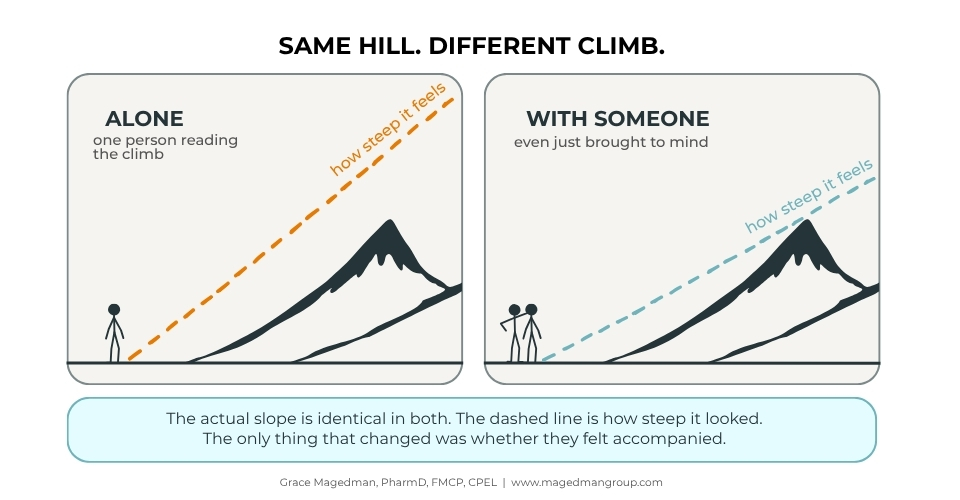
That's the whole mechanism, and it's almost unfairly simple. The climb doesn't change. Your read on whether you can make it does, based on whether you believe someone's with you. Which means a person who has quietly decided she's on her own (hyper-independence, anyone?) is looking at a steeper hill than the one actually in front of her, every single day. And she's the last to know it. To her, the incline just looks like the incline.
This isn't a soft finding either. Across large population studies, stronger social ties are associated with better survival odds, and weaker ones with higher rates of heart disease and stroke. These are associations rather than proof of causation, and drawn from broad populations, but the direction has held for decades.
Here's how the hill gets steeper without you noticing:
Every “I'm fine, focus on you.” Each one is small and polite and feels like nothing. But you never let support land, so you never gather the evidence that you have any. And after enough years, you're running on a genuine internal read that you're on your own. Not because no one would show up, but because you dismantled your own ability to believe they would.
That read is what your body responds to. Your stress load runs without the dampener, day after day, and it accumulates whether or not you ever name it.
I was surrounded by capable, decent people who would have covered for me in a heartbeat. And I sat in my office with my face going gray, deciding my pain didn't qualify.
WHAT IT COST ME AND MY TEAM
I didn't see this part coming. The cost didn't stay mine, which is why this was never a self-care problem.
They knew.
Not the details. People understand that some things aren't shared.
I was going for stoic. That's the honest word for it.
Steady, not rattled, not adding anything to anyone's load.
But stoic is something other people have to interpret. From the outside it doesn't read as steady. It reads as missing information. And people don't leave missing information alone. They fill it in, usually with something worse than the truth.
I thought I was shielding them. Everyone had so much on their plate already. Adding mine felt like a failure of leadership. What I was actually doing was teaching them, every single day, that what I needed from them stopped at the work.
They carried plenty. Work came home with all of us most nights, and that was the culture I helped build. What never came their way was anything of mine that wasn't work.
And people believe you when you teach them that. They stop offering – not because they stopped caring. Because you trained them out of it, and then you experienced the result as proof that you were right to carry it alone.
THE QUESTION I'M LEAVING YOU WITH
The walls that let me carry everything without adding to anyone's plate are the same walls that told my team I needed them for the work and nothing beyond it.
Which means the thing I was proudest of was the thing creating the distance.
But distance wasn't the only thing those walls were doing. While I was busy not letting anything in, my team was still catching something from me. They always are. A room takes its read from the person carrying the most, and they feel that person's state in their own bodies before a word gets said.
So the harder question, the one I'll pick up next, isn't what your leadership keeps out. It's what it puts in. What are the people around you absorbing from you on the days you have nothing left and show up anyway?
That's where we're going next.
For now, one thing.
The next time you tell someone else to take PTO and don't offer it to yourself, just notice you did it. That's all. Not fixed. Noticed.
If you're already thinking of who to share this with, sit with it first. This one's yours.
Send me an email ([email protected]) and tell me where it landed.