
The Beliefs That Were Never Really Yours
It happened mid-sentence.
Not in an executive meeting. Not with a room full of people watching. Just a conversation with a colleague I had worked alongside for years, a routine exchange about something I knew cold. And the word I needed wasn't there.
Not slow to arrive.
Not on the tip of my tongue.
Gone.
I watched myself rephrase around it. Smoothed over the gap so quickly I'm not sure she noticed. Then I moved on, because that's what you do when you're the person in the room who's supposed to have the answers.
What I told myself was that I was tired. Overextended. Managing too many things at once. That I needed to do better.
What I didn't have was a framework for what was actually happening.
I was at the start of a perimenopausal transition. Estrogen has receptors distributed throughout the brain, including in regions responsible for memory retrieval and verbal fluency. This isn't something they teach in pharmacy school. It barely surfaces in most medical curricula even now. And it's only just beginning to find its way into the broader conversation.
And estrogen is only part of the picture. Under chronic pressure, thyroid function and adrenal output are systems that often start compensating, years before estrogen gets the attention. By the time the cognitive symptoms become undeniable, these upstream systems have frequently been under strain for much longer. The presentation can look like distraction. Like fatigue. Like a gradual loss of sharpness that has no obvious cause.
Like a belief that you are no longer good enough.
The question I have carried since: had I known, would I have left?
If I had the language to name what was happening biologically, could I have asked for support instead of working harder to hide it? Could I have said what I needed, rather than amplifying effort and struggling in silence?
I don’t know. But I know that question is sitting in a lot of offices right now, unnamed.
Last month I asked whether the thoughts you were having about yourself during those tough years were accurate, or whether they were the output of a system running on compromised fuel. This issue is the answer.
By the way, this issue isn't just for women. Read on to see how men are impacted too.
THE CREDENTIALED MIND IS NOT IMMUNE
Here's the thing that doesn't make it into leadership literature: the people most equipped by role to hold the standard are often the last to apply any grace to themselves. We become fluent in the biology of our patients. We have almost no practice being one.
What I did when the words stopped coming was what most high-performing executives do. I worked harder. I prepared more obsessively. I stayed later. I developed workarounds I did not call workarounds. And I interpreted every gap, every slow retrieve, every moment of cognitive friction as evidence that I was losing my edge.
The belief felt like honest self-assessment. Like knowing my limits.
It was not.
THE ANSWER TO THE LAST NEWSLETTER'S QUESTIONS
Were those thoughts an accurate read of your limits?
Here's what was actually happening.
Under sustained demand, the brain’s threat-detection system prioritizes encoding emotionally charged, threat-relevant experiences. The moment the word stops. The meeting where you didn't have the answer. The email you reread the next morning with disbelief. Those experiences get flagged as survival-relevant and stored with precision.
The years of competence, the decisions that held, the expertise that was real and earned, those don't receive the same flag. They're accessible, technically, but they're not the files your system reaches for when you're already under pressure.
What you experience as a realistic appraisal of your capabilities is, in part, a retrieval problem. The record is biased by which experiences got encoded as threats and which did not. You're not reading your full history. You're reading the version the stressed brain decided was most important.
And the inflammatory markers we discussed previously cross the blood-brain barrier. Neuroinflammation has been associated with altered emotional processing in the brain, including greater sensitivity to threat-relevant information. The same ambiguous situation that would've read as manageable when your system was running well reads as evidence of inadequacy when it's not.
Your realistic appraisal of what you were capable of was working from biased instruments. That's not a character assessment. It's a biology report.
THE WIRING
There's a second mechanism, and it runs deeper.
Neurons that fire together wire together. This is the literal architecture of how the brain builds efficiency. A thought pattern that fires repeatedly, under high-stakes conditions, becomes faster. More automatic. Harder to distinguish from reflex.
For me, that pattern was "precision as protection." In clinical pharmacy, the conservative call was the right call. You don't release something before it's ready when the cost of error is a life. That circuit ran really well and protected the people in my care more times than I could count.
When I moved into coaching and entrepreneurship, the same circuit was still running. Same signal: not ready, refine more, master before you ship.
The context had changed. The wiring hadn't received the update.
The belief that I was being appropriately rigorous, that I knew my limits, was the circuit doing exactly what it was built to do.... in an environment that no longer required it.
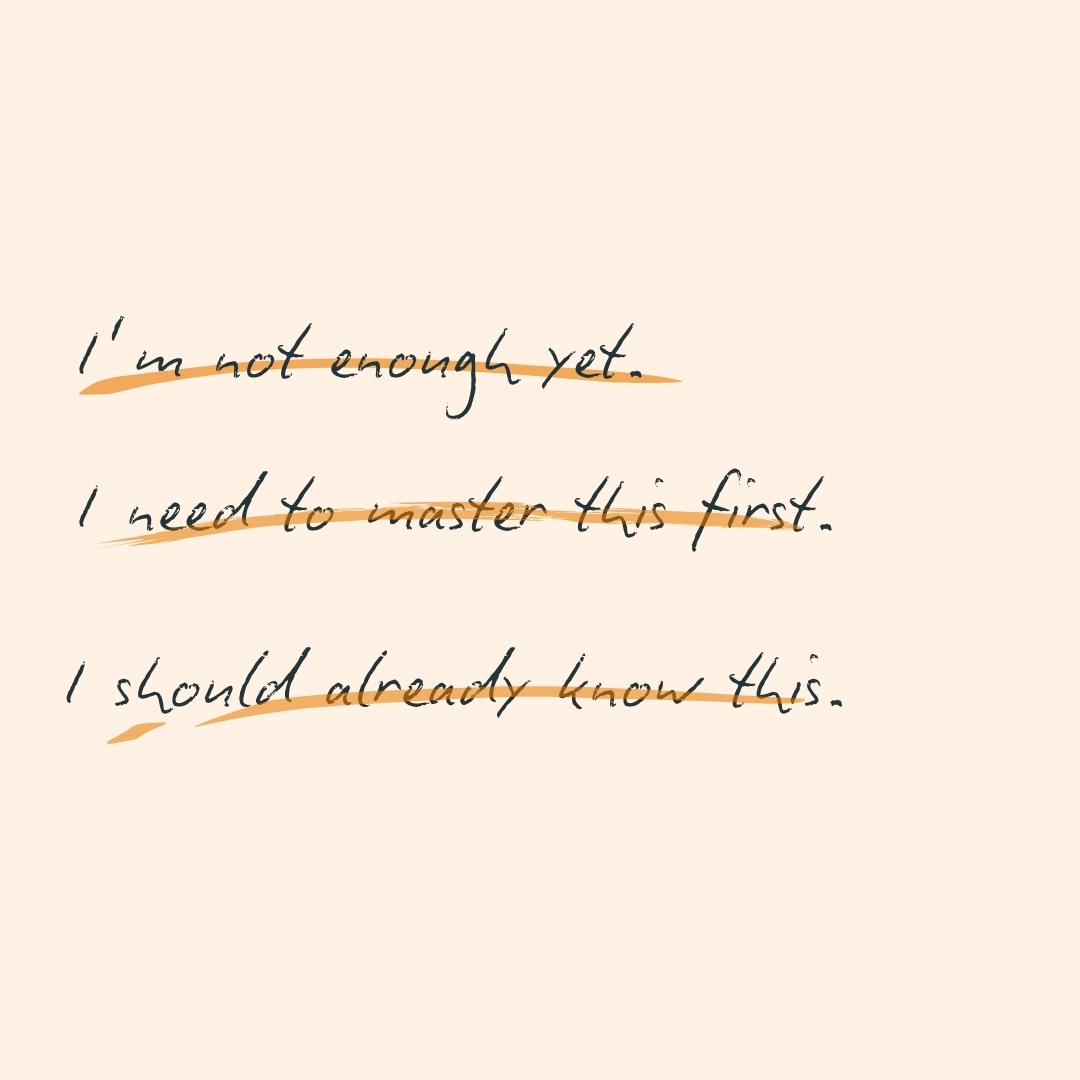
This is what makes inherited beliefs so difficult to see: they don't announce themselves as external.
They present as judgment.
As self-knowledge.
As a clear-eyed read of what you are actually capable of.
The fact that they have been running for years, in your own voice, makes them nearly impossible to question from inside the system generating them.
A NOTE FOR THE MEN READING THIS
The hormonal piece I've described is specific to my experience as a woman navigating perimenopause during a major professional transition.
But the experience is not exclusive to women.
Research has documented a measurable, population-level decline in testosterone in men over recent decades, a trend researchers have linked, in part, to rising chronic stress loads. Testosterone influences working memory, executive function, and emotional regulation through pathways that are distinct from estrogen’s. The mechanisms differ.
The experience can be surprisingly familiar: a biological shift producing real cognitive changes, interpreted as a personal failing rather than physiology.
A gradual loss of sharpness with no obvious cause, and a story that fills in the gap.
The question is the same: are the thoughts you're having about yourself an accurate reflection of what you are capable of, or are they the output of a system running below its own baseline?
Beliefs inform thoughts.
Thoughts shape emotions.
Emotions drive behaviors.
Behaviors produce results.
Most leadership content treats this as a mindset problem, something to address from the top with enough awareness and intention. What the Functional Resilience Framework adds is this: the cascade doesn't just start with your beliefs. It starts with the biological substrate generating them.
You cannot think your way to a different outcome if the instrument producing the thought has not been recalibrated.
Insight is necessary.
It isn't sufficient.
HOW YOU LEAD YOURSELF IS HOW YOU LEAD OTHERS.
That's not a motivational statement. It's a systems observation.
If the input to that cascade has been running on distorted data, about your limits, your worth, what you're actually capable of, then what the people around you have received is not you at your actual capacity. It's the output of a system that hadn't yet been seen clearly.
That question does not resolve by the end of a newsletter.
It resolves with different work.
Before you close your laptop tonight, name three things that were true about your leadership this week that you haven't let yourself actually feel yet. Not a gratitude list. A calibration exercise. The instrument works better when both sides of the record are active.
One more thing: most women spend years attributing their symptoms to stress, sleep, or getting older, when the pattern is right there in their hormonal data. There is a way to see that pattern clearly, connect it to what you’ve been experiencing, and build an actual plan around it. Not diagnostic. Not a prescription. Just specificity, which most of us have never had. If you’re curious, send me a quick email: [email protected].
If you know a woman in your circle who is navigating a professional challenge alongside the cognitive and possibly hormonal shifts, forward this to her. It may be the very thing she needs to read today.
The internal critic is not your most reliable narrator.
It's your most practiced one.
There is a difference.