
Renter with an Owner's Mindset | Vitality Leadership Institute
Eight months pregnant, I walked the new tower for the hundredth time.
The building was finished. It was not yet a hospital. There were empty rooms ready to be deployed as pharmacy and sterile compounding spaces, and the places where children’s medications would be stored and prepped, before inspectors from the State Board of Pharmacy or the Department of Public Health could sign off and let us open.
The organization never assigned me that. I need to say it plainly, because everything after depends on it. The team was good and capable. But I was the pharmacist-in-charge. My license was tied to what would happen in those rooms long after the tower opened. The risk was already mine, attached to my name, and through my name, to my family. So I made sure the work was mine too. I walked every room that touched a medication, checking what was finished against what was not, what would pass against what would fail. Eleven hour days. Twelve hour days. On my feet, eight months along.
The deadline underneath every other deadline was not on any project plan. The tower had to be open before the baby came.
Here's the part I need to get right. I didn't push through that season ignoring what I knew. What I understand now, I did not understand then. I'm a pharmacist. Today I could tell you what months of relentless stress does to a body, pregnant or not. Back then, none of it crossed my mind. It never occurred to me that what I lived under might be reaching the baby I was carrying. The tiredness, the forgetfulness, the strange flatness, I blamed on pregnancy and kept walking. As long as I could keep going, everything was fine.
By then I had lost something bigger than discipline or judgment. I had lost the ability to read my own body. The signals were there. I could no longer see them as signals.
THE RENTER WHO ACTS LIKE AN OWNER
I was an employee. A renter, technically. The organization had no real stake in me, not the kind I had in it. If I left, or broke, the role would be posted and someone else would walk that tower. That's how a job works, and it's just as true of yours.
But I didn't work like a renter. I worked like an owner. I took on the risk, the exposure, the long days that belonged to my family, and carried all of it as if the building were mine, the outcome mine, and the failure, if it came, mine to live with.
A renter with an owner’s mindset. High-performing healthcare leaders do this constantly. We invest at 'ownership' level in roles already priced as 'replaceable.' And rarely for a title or a bonus. We do it because the work has become who we are. And because everything around us rewards exactly that. The passed inspection. The praise. The reputation for being the one who never misses. The system keeps applauding the very thing that is costing us the most.
WHY YOU COULDN'T JUST LEAVE
The last issue named what the environment had done. It left a question hanging underneath, one I suspect some of you have sat with since. If the environment was doing this to me, why did I stay so long?
It's a fair question, but the wrong shape. It assumes staying was a failure of clarity or nerve. It was neither. Staying was rational, and I can show you why.
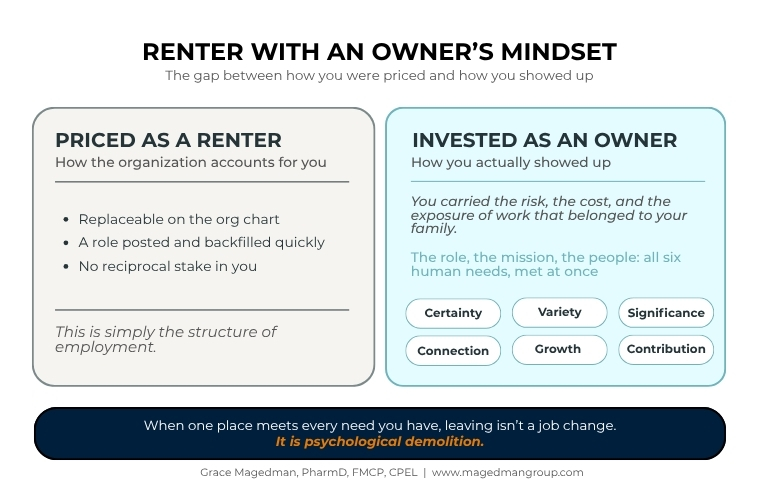
Tony Robbins identified the six human needs that drive all behavior: certainty, variety, significance, connection, growth, and contribution. He gave me the vocabulary. What I want to give you is what I saw when I held it against a healthcare executive’s life.
One place was meeting all six. The role, the organization, the kids we served, the mission running through it, all at once.
Read this against your own life, not mine. Certainty is the steady paycheck that lets you provide without a second thought. Variety is the new programs you build, and the disruption too: inspections, shifting regulations, pressure that never lets the work go stale. Significance is being the person who matters, trusted to leave a legacy. Connection is the colleagues who carry the same weight and the team that you get to develop and grow with, no explanation needed. Growth is every new system and crisis forcing you to become more. And contribution gives it a point: what you do reaches real lives, and counts.
Now notice what that means. When one place is meeting all six human needs at once, leaving it isn't a job change. It is psychological demolition. You're not weighing whether to switch employers. You're weighing whether to tear down the entire structure that holds up who you are.
That's the trap. Not weakness. Not a shortage of options. A single role, with a mission and an organization around it, became the sole supplier of every need a person has, while the employer who held it priced you, on its books, as a renter. They even named it for us. The golden handcuffs. We rarely notice that gold handcuffs are still handcuffs.
WHERE THE WORK ACTUALLY STARTS
I'm not going to tell you to leave. This issue doesn't resolve that, and it shouldn't. That decision is yours, and it deserves far more than a fast answer from anyone, including me.
What I will tell you is where the work starts. It's not where most people look.
It doesn't start with your body, though your body has been paying for all this, and we will get to that. It doesn't start with updating your resume either. It starts with a question most leaders are too busy to sit still and answer.
What do you actually value, and do your days show it?
Not the values painted on the lobby wall.
Yours. Named in your own words.
Most of us have never written them down.
We are too deep in the 'walking of the tower' to ask whether it was ever ours to carry.
Here is the one thing I will ask of you:
Before the week is out, write down your three core values. Only three.
Then look at last week’s calendar, and ask how much of it those three values would recognize as yours.
You may not like the answer. That discomfort is information. Resist the urge to fix it or explain it away. It may also be the first thing in a long time that fully belongs to you.
You spent years building a place that was never going to be yours. The quieter question, the harder one, is what it would take to build something that is.
Not a company. I'm not pointing you toward starting your own thing. And not only toward the next role, the higher title, the better-resourced version of the same job. A new building is still rented if you walk in carrying the old pattern. Something that is yours is a working life your own values would recognize, wherever it happens to be housed. That's why the values come first.
It starts with an honest look at what the last place cost you.
You already know the hours, and the dinners you didn't make it home for. What you may not have looked at is what it cost your body.
It was never only a feeling. Your body was producing real, measurable signals the whole time you walked that tower. Numbers you could have read, and most of us never do. That's what the next issue is about.
If this landed somewhere familiar, forward it to one healthcare leader in your circle who needs this.