
Glass Balls, Rubber Balls
I was running a workshop last fall for a room full of healthcare leaders when someone asked a question I've been thinking about ever since.
She was referencing a framework most people in the room already knew. Brian Dyson, then CEO of Coca-Cola, introduced it during a commencement address at Georgia Tech in 1991. Imagine life as a game of juggling five balls: work, family, health, friends, and spirit. Work is rubber. Drop it and it bounces back. The other four are glass. Drop them and they chip, crack, or shatter. They do not simply return to your hand.
In healthcare, that tends to get inverted. The work– patient safety, regulatory compliance, the 3am call– often becomes the glass. Everything else gets reclassified as rubber by default.
What she was really asking was: once you've put a rubber ball down, how do you know when it's been on the ground long enough to start changing?
Before I could answer, someone else in the room added: "Leadership is what turns glass balls into rubber ones."
The room nodded. Then went quiet.
Because neither question had a clean answer. Including from me.
That silence has been sitting with me since. This issue is my attempt to finish it.
THE FRAMEWORK STOPS WHERE IT GETS INTERESTING
Dyson's model is useful precisely because it is simple. Work can be set down and recovered. The things that make a life– relationships, health, the internal sense of purpose that sustains you through hard stretches– cannot be recovered in the same way once they've been damaged by prolonged neglect.
For most professionals, the sorting is intuitive enough. But healthcare leadership life complicates it in a specific way. When your work includes patient outcomes and safety events, regulatory risk, and decisions that affect other people's lives, it stops being a rubber ball. It becomes glass.
Which means the inversion has already happened before you've consciously sorted anything: the role reclassifies your work for you. And in the absence of a deliberate framework, everything personal [health, relationships, your own internal life] absorbs the rubber designation by default. Not because you decided it was recoverable, but because the role needed it to be.
But there are three questions that make it less arbitrary:
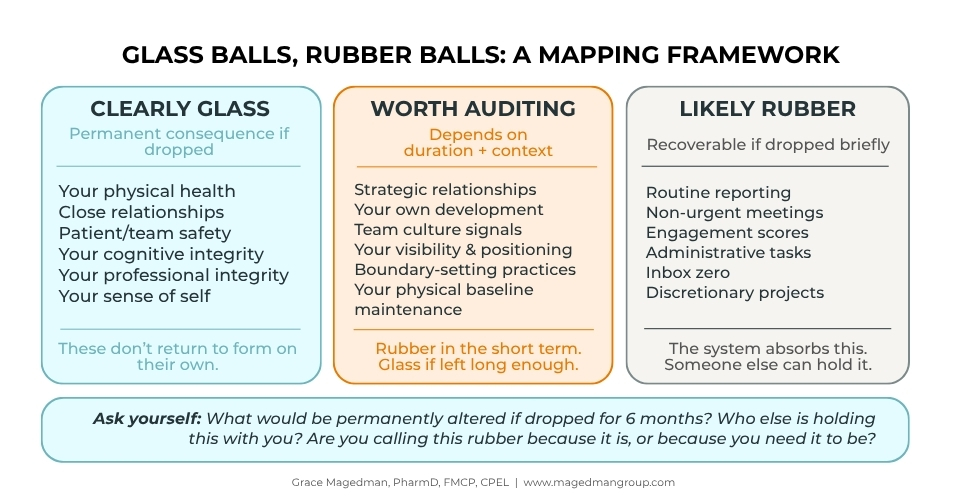
What would be permanently altered if I dropped this and didn't pick it back up for six months?
Glass breaks on impact and stays broken. Rubber bounces and returns to its original form. If the honest answer is that something would be fundamentally changed– a relationship, a health trajectory, your own sense of who you are– that's glass, regardless of what category it looks like from the outside.
Who else is holding this ball with me?
Glass balls held by only one person are the most fragile. Rubber balls often have institutional redundancy built in: someone else can cover the meeting, the system has a backup, the organization will absorb the gap. When you are the sole point of contact between a ball and the floor, treat it as glass until proven otherwise.
Am I calling this rubber because it is, or because I need it to be?
This is the most honest question and the hardest to answer in the middle of a crisis. Necessity is a very efficient reclassifier.
ON LEADERSHIP TURNING GLASS INTO RUBBER
The comment from the room was right about one thing and wrong about one important thing.
Where it’s right:
At an organizational level, strong leadership genuinely does convert fragile systems into resilient ones. A medication error that once required individual vigilance becomes a near-impossible event after barcode verification and automated dispensing. Safety protocols, redundant systems, trained teams... these are leadership turning glass into rubber at scale. That’s the work. That observation deserves the nodding it got.
Where it breaks down:
It doesn’t transfer well to the personal domain. You can’t systematize your marriage. You can’t build a redundant system for your health. You can’t engineer a protocol that keeps your closest relationships from feeling the cost of sustained absence. In those domains, the glass stays glass regardless of your leadership competency. Applying an organizational solution to a personal problem is one of the most common and least examined mistakes I see in this work.
And yet the two get conflated constantly. I’ve watched very competent leaders absorb significant personal damage and call it a trade-off. The organizational logic was sound. The personal cost was not.
THE QUESTION NOBODY ANSWERED: HOW TO KEEP RUBBER FROM BECOMING GLASS
For many years I managed the glass balls of a large pediatric health system with genuine skill. I was good at it. Safety, compliance, operational integrity. I held them. What I was simultaneously doing, without quite deciding to, was setting down family relationships, close friendships, and my own health.
I told myself those were rubber balls. Recoverable. I’d get back to them.
Some of them were. Some of them weren't.
I couldn't tell the difference until years later, standing outside the stretch that had caused it.
What I didn’t have then was a rhythm for auditing which balls were on the ground and how long they’d been there.
Not a daily check-in. Not a mindfulness practice.
A structured, periodic question: what have I put down, how long has it been there, and what is the realistic window before the material changes?
Because rubber does not stay rubber indefinitely, and a ball is not always the right analogy. A rubber band stretched gradually, held under tension for long enough, does something different than bouncing. It doesn’t return to form on impact. It either stays permanently deformed, stretched beyond its original shape, or it snaps. The material looks intact from the outside until it doesn’t.
That’s a more accurate picture of what happens to the things we classify as recoverable when we leave them under tension for too long. The question isn’t only how long has this been on the ground. It’s how much tension has it been holding while it waited.
A useful rhythm looks something like this:
At whatever interval makes sense given your role and season– monthly is often right– ask yourself which balls are currently on the ground, how long each has been there, and how much tension each one is carrying.
The point is not to pick them all back up immediately. Sometimes the rubber ball needs to stay on the ground for a season and that’s the right call. The point is to make that a deliberate decision, rather than one that happens to you.
The question that doesn’t have an easy answer is how you identify the threshold– the point at which a rubber ball has been under tension long enough that the material is beginning to change.
I don't have a clean answer to it. Neither did the room.
That threshold requires knowing something about yourself, your relationships, and your history that no framework can supply from the outside.
FINAL THOUGHT
What’s currently on the floor? And how long has it been there?
Don’t answer quickly. The honest answer usually takes longer to surface than the convenient one.
If someone in your circle is in the middle of a juggling act they haven’t named yet, forward this to them. They’ll recognize it.