

The Biology Underneath the Blind Spot
Last issue, I told you about the morning I sat across from my own provider and couldn’t name what was wrong with me, even though I had decades of clinical training and had been carrying the signals for months.
If that story landed somewhere familiar for you, I want to explain why.
It’s not a failure of self-awareness or a character flaw. It’s a predictable outcome of what happens to a high-functioning nervous system under sustained leadership pressure.
And once you see the mechanism, you can’t unsee it.
THE ARCHITECTURE YOUR LEADERSHIP RUNS ON
Your prefrontal cortex (PFC) is where leadership lives. Planning, judgment, emotional regulation, the ability to hold complexity under pressure. Every consequential decision you make runs through it.
Your amygdala, a subcortical structure lower in the brain, has a single job: determine whether you are safe or in danger, and mobilize accordingly. It does this in fractions of a second before you consciously register anything.
When threat is detected, resources shift. The PFC goes partially offline. The survival systems take priority. This isn’t a malfunction. Under acute threat it’s exactly right.
The problem specific to healthcare leaders is this:
your training built an extraordinarily efficient override of the signals that would normally route back up to conscious awareness. The same suppression mechanism that makes you functional in a code, a crisis, a boardroom conflict, also makes it nearly impossible to hear what your own physiology is telling you.
The clinician who couldn’t read her own signals wasn’t deficient.
She was predictable.
ACUTE VS. CHRONIC: WHY THE SLOW BURN IS THE DANGEROUS ONE
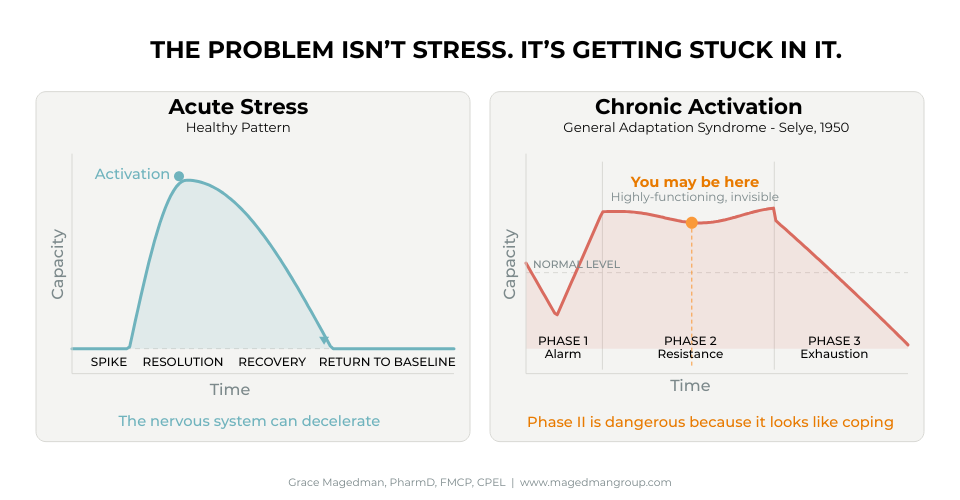
Acute stress has a shape: spike, response, resolution, recovery.
The body activates, the threat passes, and the system down-regulates. The PFC comes back online. You return to baseline.
Chronic activation doesn’t have that shape.
The stress response fires, but the signal to stop never fully arrives. So cortisol stays elevated. The amygdala stays vigilant. And the body never receives the message that it is safe enough to recover.
In clinical practice, we see its fingerprints in morning cortisol patterns, sex hormone disruption, systemic inflammation, and metabolic dysfunction. In leadership settings, it looks quieter and harder to name: a gradual narrowing of cognitive range that feels like aging, or fatigue, or personality, rather than physiology.
What degrades first isn’t your ability to activate under pressure. Most chronically dysregulated leaders can still rise to a crisis.
What degrades is the capacity to come back down.
The system can still accelerate. It can no longer decelerate.
That asymmetry is the clinical signature of a nervous system that has been running over capacity for too long.
THE SPECIFIC PROBLEM WITH BEING A HEALTHCARE LEADER
Healthcare leaders are not simply high-performers under pressure. They operate in environments that systematically train the body to override its own signals.
For clinically trained leaders, that training is explicit. Clinical distance is a professional competency. The ability to remain cognitively functional while witnessing suffering, absorbing bad news, delivering worse news, and moving through emotionally saturated environments without losing operational effectiveness... that’s a learned skill. Somatic override is built in from day one of training.
For leaders who came up through finance, operations, or strategy, the mechanism is less formal but equally effective. Healthcare organizations run on urgency. The culture rewards composure under pressure, forward momentum, decisive action. Over years, the internal signal that something is off gets filed under not relevant right now because it never is. The environment does the training. The result is the same.
Hans Selye described this progression in 1950. Most of the leaders I work with are in Phase II and have no idea Phase III has a structural logic to it.
I knew what a deteriorating patient looked like. We had protocols for recognizing it.
I couldn’t apply that knowledge to myself.
That’s not irony. That’s a predictable feature of a nervous system that has been trained for professional performance at the expense of internal attunement.
The healthcare environment produces it in almost everyone it keeps long enough.
THE CASCADE YOU MAY ALREADY BE INSIDE
When I work with healthcare executives, I use a framework to orient where we are:
Environment → Nervous System State → Cognitive Capacity → Leadership Behavior → Organizational Outcomes
Most leadership development starts at behavior:
Communicate better.
Delegate more.
Lead with more presence.
These are useful instructions if the infrastructure beneath them is intact. But if the nervous system state is chronically dysregulated, behavioral interventions are like adjusting the thermostat in a building with a failing HVAC system. The inputs are correct, but the system can't respond to them.
The core measurement question isn't: what behaviors do I need to change?
It is: what state is my nervous system in, and does it have the flexibility to regulate itself under the conditions my role demands?
That question requires different data than most healthcare leaders have ever collected about themselves.
FOR YOU, THIS WEEK
When was the last time your nervous system had a complete recovery?
Not a vacation that felt like a more expensive version of exhaustion.
An actual return to baseline.
If you can't identify a specific time, that's data. And it shows up in biomarkers before it shows up in your performance.
If this landed somewhere close to home, forward it to one healthcare leader in your circle who is performing at a high level and hasn't had a real recovery in longer than they can remember. They'll know who they are.